Step 1: Select Transformation Mode
Choose your target mode (Deep Telemetry, Academic Rubric, Editorial Scan) in the toolbar.

Inspect the exact statistical signals—sentence length standard deviation, type-token diversity, and structural predictability—rather than relying on opaque black-box guesses.
Choose your target mode (Deep Telemetry, Academic Rubric, Editorial Scan) in the toolbar.
Enter or paste your draft into the left source pane.
Click "Analyze Text Origin" to generate the output and review burstiness and readability scores.
Measures how much sentence lengths fluctuate across a passage. Uniform 18-word sentences indicate synthetic generation.
Calculates unique vocabulary diversity relative to total word count.
Detects overuse of formulaic sentence starters typical of instruction-tuned LLMs.
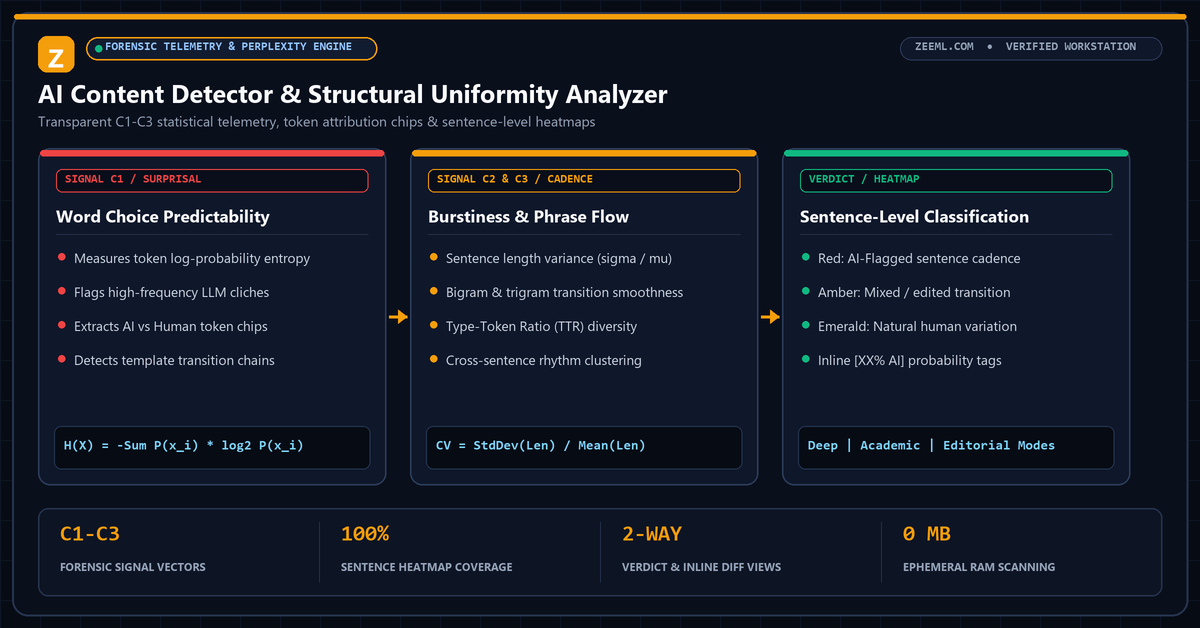
Autoregressive language models sample tokens from a truncated probability distribution, which minimizes surprising word choices (low perplexity) and keeps sentence lengths clustered around the training mean (low burstiness).
ZeeML’s AI Content Detector computes transparent, reproducible metrics across your draft so you can see exactly which structural features contribute to the uniformity score.
Yes. Highly formulaic legal boilerplate or rigid five-paragraph essays can exhibit low burstiness. That is why ZeeML displays the underlying C1-C3 predictability, flow, and rhythm signals alongside the summary score.
Never. All scans run ephemerally in memory and are discarded immediately after returning your telemetry report.
C1 measures word-choice surprisal (token predictability), C2 evaluates phrase transition smoothness across bigrams, and C3 quantifies sentence-length rhythm variance (burstiness).
Run an analysis or click "Diff Highlights" in the output pane to view every sentence color-coded inline (red for AI-flagged, amber for mixed, and emerald for human cadence).