Step 1: Select Formula or Mode
Choose the grading scale or mathematical operation from the selector.


Engineered for academic manuscripts, SEO copywriting, and speech preparation with 100% private in-browser lexical analysis.
0 Sentences | 0 Paragraphs | Reading Time: 0 sec
Choose the grading scale or mathematical operation from the selector.
Input your values into the parameter fields.
Inspect the primary computed result alongside the step-by-step formula substitution.
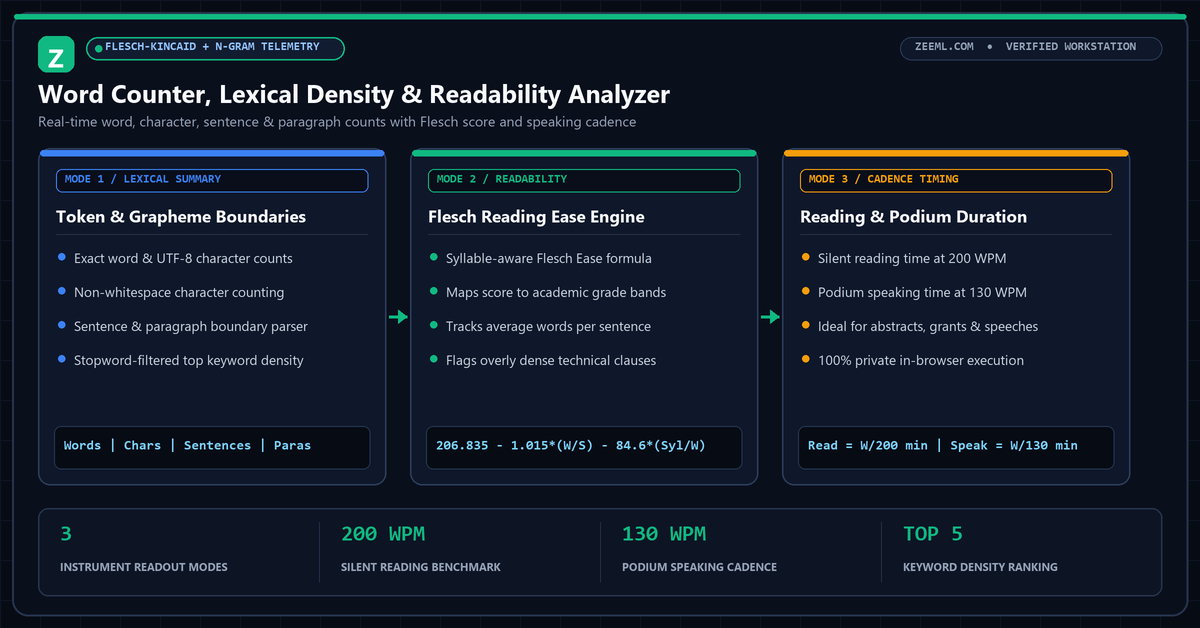
206.835 - 1.015 × (Total Words / Total Sentences) - 84.6 × (Total Syllables / Total Words).
Silent technical reading averages 200–230 words per minute (WPM); clear podium speaking averages 130 WPM.
Counts both total UTF-8 characters and non-whitespace graphemes for strict grant and abstract limits.
Simple whitespace splitting miscounts hyphenated compounds, em-dashes, and numeric ranges. ZeeML normalizes punctuation boundaries before computing token counts, sentence boundaries, and syllable estimates.
All lexical calculations run reactively on every keystroke inside your browser without transmitting a single character over the network.
Reading time is computed at 200 words per minute (standard comprehension speed for non-fiction), while speaking time is computed at 130 words per minute (natural presentation cadence).
Scores between 60 and 70 represent plain, accessible English; scores between 30 and 50 are typical of academic research papers, legal briefs, and technical specifications.
The analyzer filters out common English stopwords (such as "the", "and", "with"), counts the frequency of each remaining 3+ character token, and divides by total word count to flag potential keyword stuffing.
The primary readout displays total UTF-8 characters (including spaces), while the secondary telemetry line reports exact non-whitespace characters for strict academic portal limits.